Ashta Chamma
A digital adaptation of the traditional Ashta Chamma board game featuring local multiplayer gameplay and multiple AI difficulty levels.

Primary Constraint
Preserving traditional gameplay mechanics while creating an AI system that feels progressively challenging without violating established game rules.
Problem Context
Ashta Chamma is a game built around probabilistic movement, tactical positioning, captures, safe zones, and multiple pieces competing for progression around the board.
Translating these mechanics into software required creating a system that could consistently enforce game rules, handle complex move calculations, and provide computer-controlled opponents that remained competitive while respecting the constraints of the game.
The objective was to preserve the strategic depth of the physical game while making it accessible to modern players.
System Design Focus
The system focused on deterministic rule enforcement and AI-driven decision making.
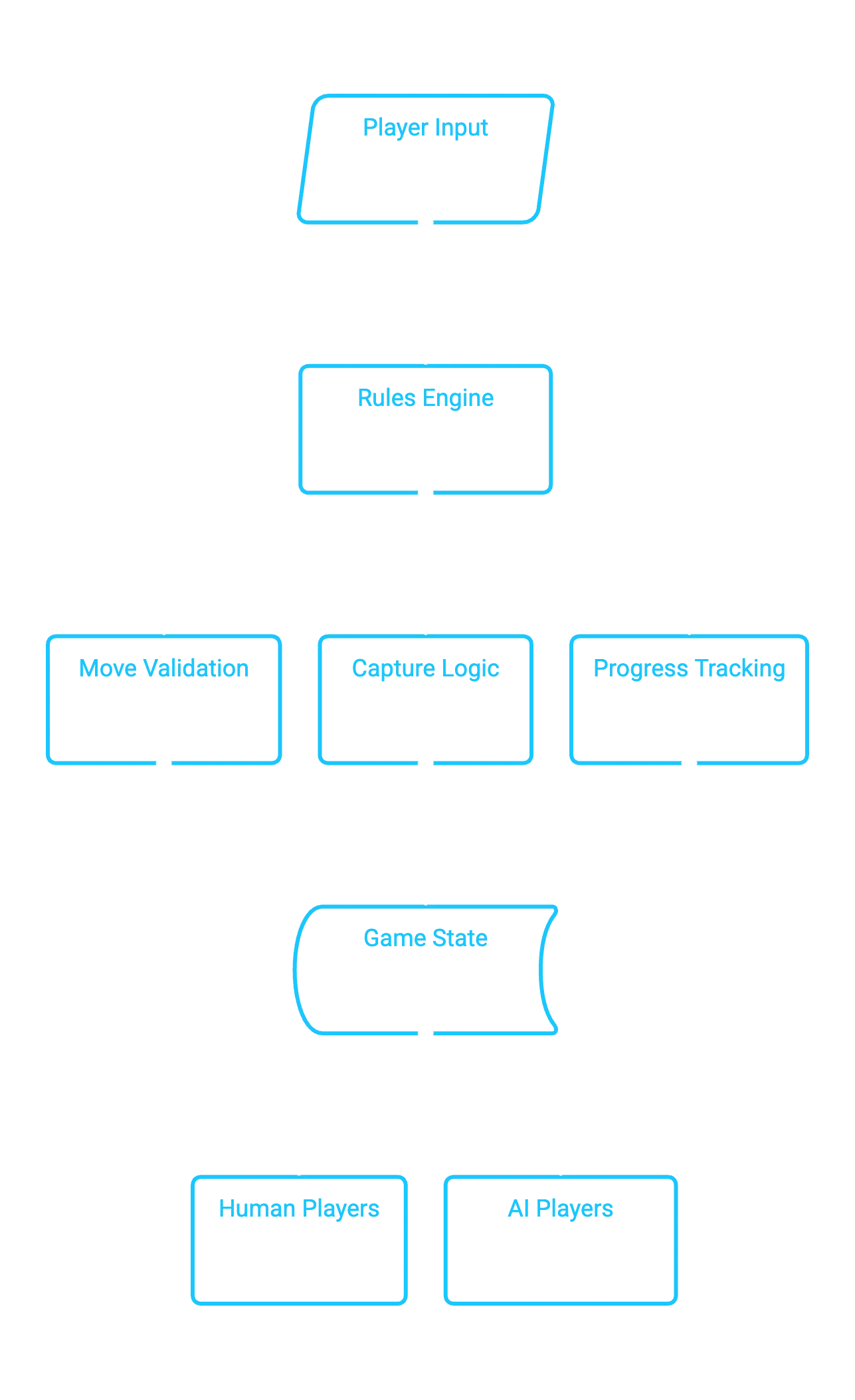
This centered on:
- Rule-based move generation and validation
- Turn sequencing and state transitions
- Multiple AI difficulty levels with distinct decision strategies
- Capture, safety zone, and progression mechanics
- Consistent game state management across all game modes
Every game action is validated through a single rules engine to ensure fairness and predictable outcomes.
What this Demonstrates
Demonstrates the ability to model complex game mechanics as deterministic software systems.
Shows experience designing game state engines, implementing strategic AI behavior, and translating traditional board game rules into intuitive digital experiences.
Preserving the strategy of a traditional board game required more than recreating the board. It required translating decades of human gameplay assumptions into deterministic software rules.
Key Technologies
selected, non-exhaustive